Abstract
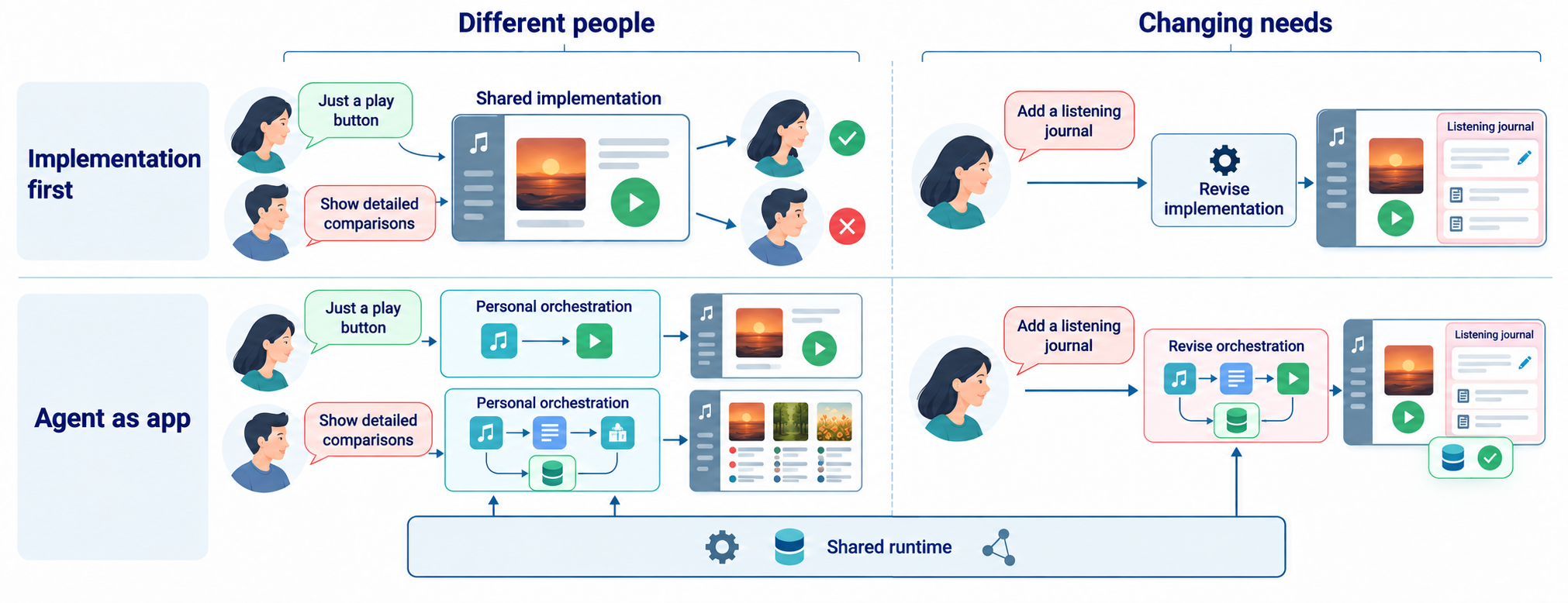
People want different things from the same application, and their needs change as they use it. Agent as App creates a personalized application from a natural-language requirement and keeps the agent responsible for its behavior during use. LiveUIAgent connects the interface, service actions, and saved information through a task-specific orchestration on a shared runtime. LiveUIBench follows the resulting application through later submissions, revisions, and return visits, measuring whether it completes the user's whole workflow.
What LiveUIBench Evaluates
The object of evaluation is the application through continued interaction. After an agent creates it from an initial requirement, the user supplies new inputs, revises earlier requests, and returns to information already saved. Each later request must remain connected to the same task.
Agent as App: the agent creates a personalized interactive workspace and continues to interpret user inputs, perform service operations, and update the interface using retained information.
The tasks span personal services, workflows using multiple services, and sequential applications sharing the same service world. Full-workflow success requires every assigned assertion to pass; assertion coverage records partial progress across the same tasks.
From Intention to Evidence
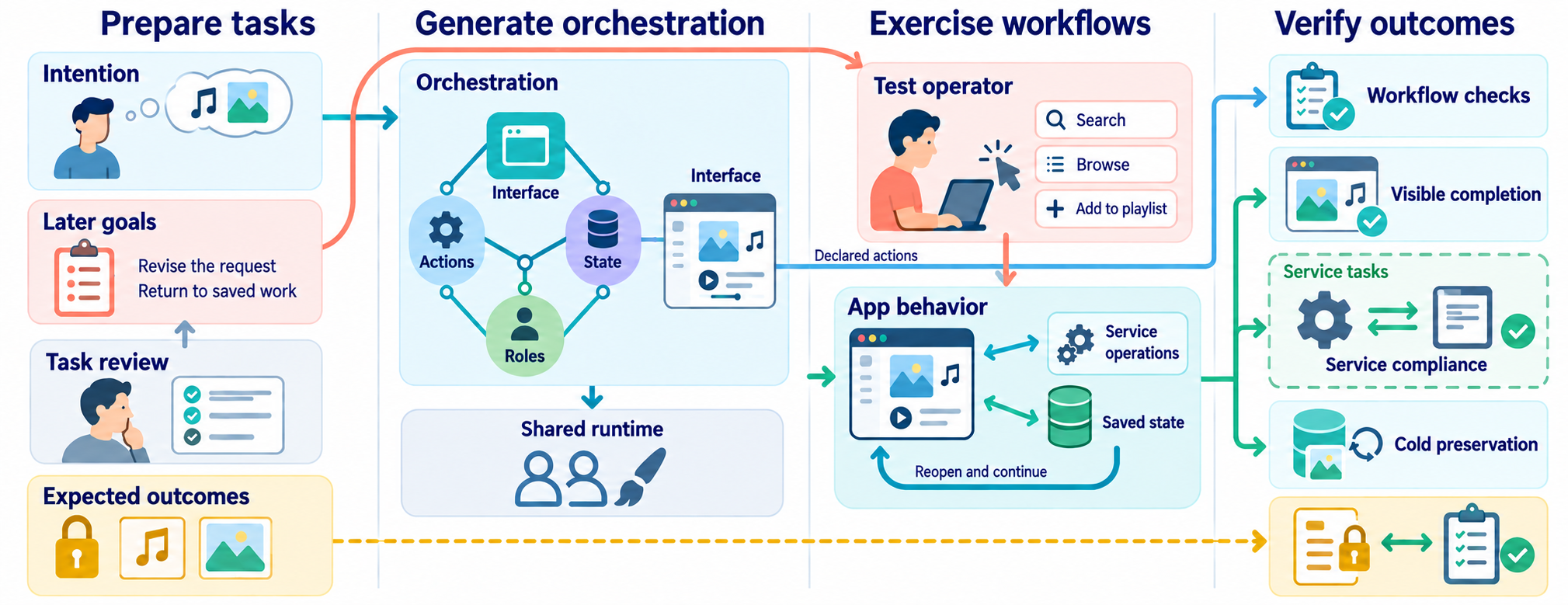
The generator receives the initial requirement and permitted service context. Later requests arrive during their assigned episodes. The model survey invokes the application's declared actions, while recorded application examples follow its visible interface. Checks follow the requested operations, displayed results, and retained state through the same sequence.
LiveUIAgent
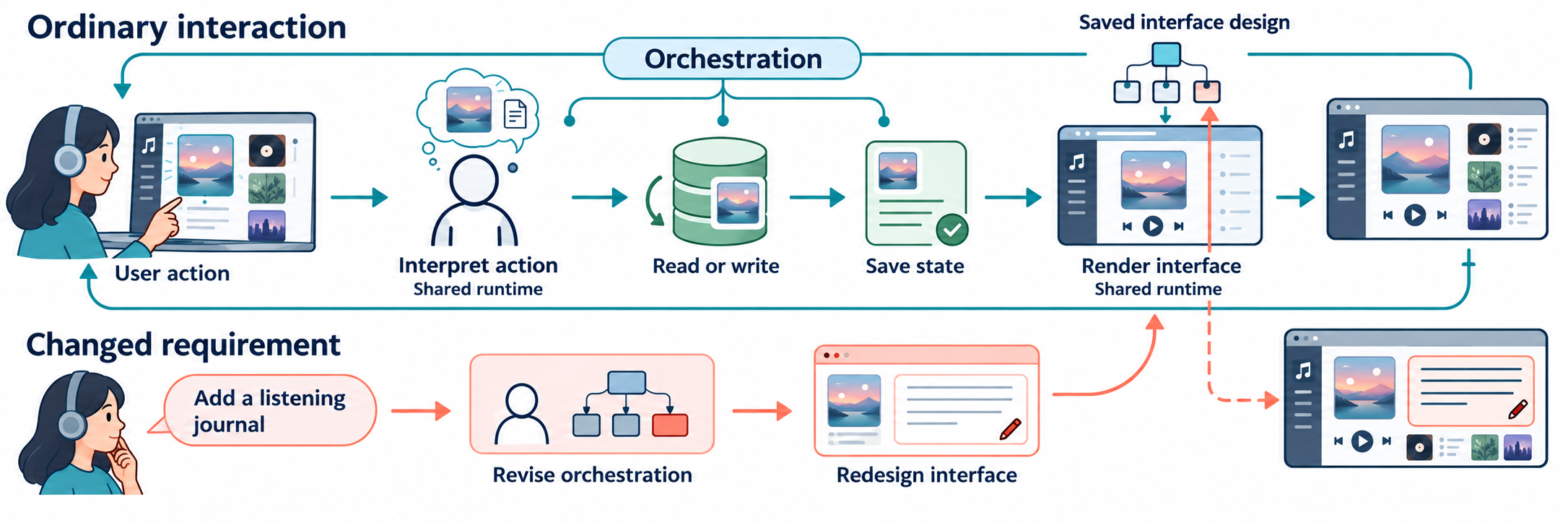
A task-specific orchestration connects interface controls, action goals, agent roles, and saved information. The shared runtime interprets a submitted input, uses the relevant services, saves its result, and renders the updated interface. Changing a requirement can revise the orchestration and interface while retaining the application's identity and information.
Opening an app is easier than completing its workflow
Leading models usually open the requested application, yet later submissions and revisions often fail. Higher coverage of individual checks can even coincide with fewer completed workflows: local successes must come together in the same application for a user to finish the task.
BibTeX
@misc{zhang2026liveuibench,
  title = {LiveUIBench: Evaluating Agent as App Workflows},
  author = {Zhang, Tong and Cheng, Yuxuan and Zhang, Ruimin and Peng, Yun and Xie, Tao},
  year = {2026},
  eprint = {2610.27977},
  archivePrefix = {arXiv},
  primaryClass = {cs.SE},
  url = {https://arxiv.org/abs/2610.27977}
}